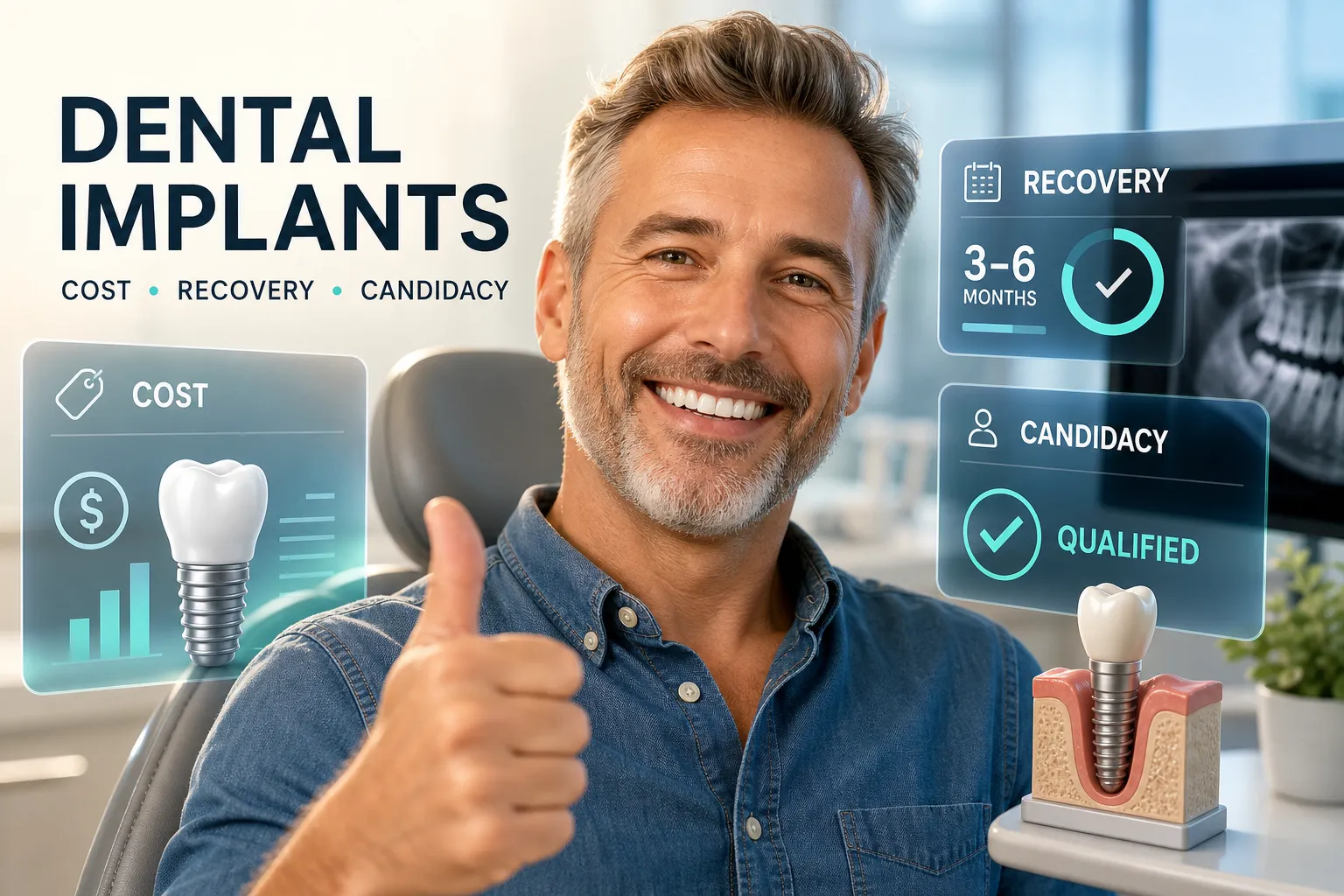
Dental Implant Cost, Recovery & Candidacy: Full Guide
Dental Implant Cost, Recovery & Candidacy: Full Guide
If you have spent time searching online for dental implant cost information, you have likely landed on dozens of articles that either offer suspiciously vague answers or overwhelm you with complex medical jargon. Naturally, trying to calculate the true cost of an implant feels frustrating, especially when you also need to understand your candidacy, bone grafting needs, and recovery expectations. Fortunately, you deserve straight, transparent answers to every question before sitting down for a consultation.
This comprehensive guide covers everything a patient should know before booking an appointment. We break down realistic 2026 dental implant cost structures, essential candidacy factors, bone grafting procedures, week-by-week recovery timelines, and long-term aftercare habits. At Envy Dental, Implants & Esthetics in Wichita, Dr. Neda Vessali helps you navigate treatment planning with complete clarity and confidence.
2026 Dental Implant Cost Breakdown and Key Factors
Itemizing Your Dental Implant Components
Most dental practices advertise a single dental implant cost ranging between $3,000 and $6,000. Generally, this total bundles three core components: the titanium implant post ($1,000 to $2,000), the connecting abutment ($300 to $500), and the custom porcelain crown ($700 to $3,000). However, auxiliary fees such as 3D CBCT diagnostic imaging ($200 to $500) or dental sedation ($300 to $800) may apply depending on your custom treatment plan.
Take the next step toward a confident, complete smile. Call Envy Dental at (316) 943-3273 or visit us at 132 N West St, Wichita, KS 67203 to schedule your consultation with Dr. Neda Vessali today!
To preserve your restoration, maintain meticulous oral hygiene: brush twice daily with soft bristles, floss with implant-safe tape or water flossers, and attend bi-annual dental cleanings. Addressing minor gum inflammation early protects against peri-implantitis and keeps your investment secure. Furthermore, learn how to prevent complications by reading our guide on can dental implants fall out.
Take the next step toward a confident, complete smile. Call Envy Dental at (316) 943-3273 or visit us at 132 N West St, Wichita, KS 67203 to schedule your consultation with Dr. Neda Vessali today!
Dental implants maintain a clinical success rate exceeding 95% in healthy patients. While the titanium post is designed to last a lifetime, the custom crown typically undergoes normal wear and requires replacement after 10 to 15 years.
To preserve your restoration, maintain meticulous oral hygiene: brush twice daily with soft bristles, floss with implant-safe tape or water flossers, and attend bi-annual dental cleanings. Addressing minor gum inflammation early protects against peri-implantitis and keeps your investment secure. Furthermore, learn how to prevent complications by reading our guide on can dental implants fall out.
Take the next step toward a confident, complete smile. Call Envy Dental at (316) 943-3273 or visit us at 132 N West St, Wichita, KS 67203 to schedule your consultation with Dr. Neda Vessali today!
Dental implants maintain a clinical success rate exceeding 95% in healthy patients. While the titanium post is designed to last a lifetime, the custom crown typically undergoes normal wear and requires replacement after 10 to 15 years.
To preserve your restoration, maintain meticulous oral hygiene: brush twice daily with soft bristles, floss with implant-safe tape or water flossers, and attend bi-annual dental cleanings. Addressing minor gum inflammation early protects against peri-implantitis and keeps your investment secure. Furthermore, learn how to prevent complications by reading our guide on can dental implants fall out.
Take the next step toward a confident, complete smile. Call Envy Dental at (316) 943-3273 or visit us at 132 N West St, Wichita, KS 67203 to schedule your consultation with Dr. Neda Vessali today!
Days 4–14: Soft tissue and surgical sites heal rapidly. Swelling resolves, allowing most patients to resume normal routines within two days.
Months 3–6: Osseointegration takes place beneath the gums as natural bone fuses with titanium. Learn more about how dental implants work during this crucial fusion phase.
Longevity and Essential Aftercare Habits
Dental implants maintain a clinical success rate exceeding 95% in healthy patients. While the titanium post is designed to last a lifetime, the custom crown typically undergoes normal wear and requires replacement after 10 to 15 years.
To preserve your restoration, maintain meticulous oral hygiene: brush twice daily with soft bristles, floss with implant-safe tape or water flossers, and attend bi-annual dental cleanings. Addressing minor gum inflammation early protects against peri-implantitis and keeps your investment secure. Furthermore, learn how to prevent complications by reading our guide on can dental implants fall out.
Take the next step toward a confident, complete smile. Call Envy Dental at (316) 943-3273 or visit us at 132 N West St, Wichita, KS 67203 to schedule your consultation with Dr. Neda Vessali today!
Days 1–3: Mild swelling and minor discomfort peak around day two or three before steadily declining. Patients easily manage symptoms using prescribed or over-the-counter pain relievers alongside ice pack applications.
Days 4–14: Soft tissue and surgical sites heal rapidly. Swelling resolves, allowing most patients to resume normal routines within two days.
Months 3–6: Osseointegration takes place beneath the gums as natural bone fuses with titanium. Learn more about how dental implants work during this crucial fusion phase.
Longevity and Essential Aftercare Habits
Dental implants maintain a clinical success rate exceeding 95% in healthy patients. While the titanium post is designed to last a lifetime, the custom crown typically undergoes normal wear and requires replacement after 10 to 15 years.
To preserve your restoration, maintain meticulous oral hygiene: brush twice daily with soft bristles, floss with implant-safe tape or water flossers, and attend bi-annual dental cleanings. Addressing minor gum inflammation early protects against peri-implantitis and keeps your investment secure. Furthermore, learn how to prevent complications by reading our guide on can dental implants fall out.
Take the next step toward a confident, complete smile. Call Envy Dental at (316) 943-3273 or visit us at 132 N West St, Wichita, KS 67203 to schedule your consultation with Dr. Neda Vessali today!
Understanding recovery helps eliminate anxiety after surgery. Here is what to expect during healing:
Days 1–3: Mild swelling and minor discomfort peak around day two or three before steadily declining. Patients easily manage symptoms using prescribed or over-the-counter pain relievers alongside ice pack applications.
Days 4–14: Soft tissue and surgical sites heal rapidly. Swelling resolves, allowing most patients to resume normal routines within two days.
Months 3–6: Osseointegration takes place beneath the gums as natural bone fuses with titanium. Learn more about how dental implants work during this crucial fusion phase.
Longevity and Essential Aftercare Habits
Dental implants maintain a clinical success rate exceeding 95% in healthy patients. While the titanium post is designed to last a lifetime, the custom crown typically undergoes normal wear and requires replacement after 10 to 15 years.
To preserve your restoration, maintain meticulous oral hygiene: brush twice daily with soft bristles, floss with implant-safe tape or water flossers, and attend bi-annual dental cleanings. Addressing minor gum inflammation early protects against peri-implantitis and keeps your investment secure. Furthermore, learn how to prevent complications by reading our guide on can dental implants fall out.
Take the next step toward a confident, complete smile. Call Envy Dental at (316) 943-3273 or visit us at 132 N West St, Wichita, KS 67203 to schedule your consultation with Dr. Neda Vessali today!
Understanding recovery helps eliminate anxiety after surgery. Here is what to expect during healing:
Days 1–3: Mild swelling and minor discomfort peak around day two or three before steadily declining. Patients easily manage symptoms using prescribed or over-the-counter pain relievers alongside ice pack applications.
Days 4–14: Soft tissue and surgical sites heal rapidly. Swelling resolves, allowing most patients to resume normal routines within two days.
Months 3–6: Osseointegration takes place beneath the gums as natural bone fuses with titanium. Learn more about how dental implants work during this crucial fusion phase.
Longevity and Essential Aftercare Habits
Dental implants maintain a clinical success rate exceeding 95% in healthy patients. While the titanium post is designed to last a lifetime, the custom crown typically undergoes normal wear and requires replacement after 10 to 15 years.
To preserve your restoration, maintain meticulous oral hygiene: brush twice daily with soft bristles, floss with implant-safe tape or water flossers, and attend bi-annual dental cleanings. Addressing minor gum inflammation early protects against peri-implantitis and keeps your investment secure. Furthermore, learn how to prevent complications by reading our guide on can dental implants fall out.
Take the next step toward a confident, complete smile. Call Envy Dental at (316) 943-3273 or visit us at 132 N West St, Wichita, KS 67203 to schedule your consultation with Dr. Neda Vessali today!
Integrating a preparatory graft extends the total treatment timeline from 3–6 months to roughly 9–12 months. Understanding this timeline early allows you to plan your restorative journey accurately.
Understanding recovery helps eliminate anxiety after surgery. Here is what to expect during healing:
Days 1–3: Mild swelling and minor discomfort peak around day two or three before steadily declining. Patients easily manage symptoms using prescribed or over-the-counter pain relievers alongside ice pack applications.
Days 4–14: Soft tissue and surgical sites heal rapidly. Swelling resolves, allowing most patients to resume normal routines within two days.
Months 3–6: Osseointegration takes place beneath the gums as natural bone fuses with titanium. Learn more about how dental implants work during this crucial fusion phase.
Longevity and Essential Aftercare Habits
Dental implants maintain a clinical success rate exceeding 95% in healthy patients. While the titanium post is designed to last a lifetime, the custom crown typically undergoes normal wear and requires replacement after 10 to 15 years.
To preserve your restoration, maintain meticulous oral hygiene: brush twice daily with soft bristles, floss with implant-safe tape or water flossers, and attend bi-annual dental cleanings. Addressing minor gum inflammation early protects against peri-implantitis and keeps your investment secure. Furthermore, learn how to prevent complications by reading our guide on can dental implants fall out.
Take the next step toward a confident, complete smile. Call Envy Dental at (316) 943-3273 or visit us at 132 N West St, Wichita, KS 67203 to schedule your consultation with Dr. Neda Vessali today!
Integrating a preparatory graft extends the total treatment timeline from 3–6 months to roughly 9–12 months. Understanding this timeline early allows you to plan your restorative journey accurately.
Understanding recovery helps eliminate anxiety after surgery. Here is what to expect during healing:
Days 1–3: Mild swelling and minor discomfort peak around day two or three before steadily declining. Patients easily manage symptoms using prescribed or over-the-counter pain relievers alongside ice pack applications.
Days 4–14: Soft tissue and surgical sites heal rapidly. Swelling resolves, allowing most patients to resume normal routines within two days.
Months 3–6: Osseointegration takes place beneath the gums as natural bone fuses with titanium. Learn more about how dental implants work during this crucial fusion phase.
Longevity and Essential Aftercare Habits
Dental implants maintain a clinical success rate exceeding 95% in healthy patients. While the titanium post is designed to last a lifetime, the custom crown typically undergoes normal wear and requires replacement after 10 to 15 years.
To preserve your restoration, maintain meticulous oral hygiene: brush twice daily with soft bristles, floss with implant-safe tape or water flossers, and attend bi-annual dental cleanings. Addressing minor gum inflammation early protects against peri-implantitis and keeps your investment secure. Furthermore, learn how to prevent complications by reading our guide on can dental implants fall out.
Take the next step toward a confident, complete smile. Call Envy Dental at (316) 943-3273 or visit us at 132 N West St, Wichita, KS 67203 to schedule your consultation with Dr. Neda Vessali today!
Following tooth extraction, jawbone resorption naturally occurs over time. To counteract bone loss, clinicians utilize targeted grafting methods:
Socket Preservation: Placed immediately during tooth extraction, healing in 3 to 4 months.
Guided Bone Regeneration: Utilizes protective membranes to rebuild missing bone tissue over 4 to 6 months.
Sinus Lifts: Elevates the sinus floor in the upper molar region, requiring 4 to 6 months of healing before implant placement.
Integrating a preparatory graft extends the total treatment timeline from 3–6 months to roughly 9–12 months. Understanding this timeline early allows you to plan your restorative journey accurately.
Understanding recovery helps eliminate anxiety after surgery. Here is what to expect during healing:
Days 1–3: Mild swelling and minor discomfort peak around day two or three before steadily declining. Patients easily manage symptoms using prescribed or over-the-counter pain relievers alongside ice pack applications.
Days 4–14: Soft tissue and surgical sites heal rapidly. Swelling resolves, allowing most patients to resume normal routines within two days.
Months 3–6: Osseointegration takes place beneath the gums as natural bone fuses with titanium. Learn more about how dental implants work during this crucial fusion phase.
Longevity and Essential Aftercare Habits
Dental implants maintain a clinical success rate exceeding 95% in healthy patients. While the titanium post is designed to last a lifetime, the custom crown typically undergoes normal wear and requires replacement after 10 to 15 years.
To preserve your restoration, maintain meticulous oral hygiene: brush twice daily with soft bristles, floss with implant-safe tape or water flossers, and attend bi-annual dental cleanings. Addressing minor gum inflammation early protects against peri-implantitis and keeps your investment secure. Furthermore, learn how to prevent complications by reading our guide on can dental implants fall out.
Take the next step toward a confident, complete smile. Call Envy Dental at (316) 943-3273 or visit us at 132 N West St, Wichita, KS 67203 to schedule your consultation with Dr. Neda Vessali today!
Sufficient jawbone density serves as the foundation for permanent implant integration. Using advanced 3D Cone Beam CT imaging, Dr. Vessali measures bone height and width precisely. If bone resorption has occurred following tooth loss, preparatory grafting restores structural support so your implant post remains securely anchored.
Bone Grafting Explained: Timelines and Procedures
Types of Dental Bone Grafts
Following tooth extraction, jawbone resorption naturally occurs over time. To counteract bone loss, clinicians utilize targeted grafting methods:
Socket Preservation: Placed immediately during tooth extraction, healing in 3 to 4 months.
Guided Bone Regeneration: Utilizes protective membranes to rebuild missing bone tissue over 4 to 6 months.
Sinus Lifts: Elevates the sinus floor in the upper molar region, requiring 4 to 6 months of healing before implant placement.
Integrating a preparatory graft extends the total treatment timeline from 3–6 months to roughly 9–12 months. Understanding this timeline early allows you to plan your restorative journey accurately.
Understanding recovery helps eliminate anxiety after surgery. Here is what to expect during healing:
Days 1–3: Mild swelling and minor discomfort peak around day two or three before steadily declining. Patients easily manage symptoms using prescribed or over-the-counter pain relievers alongside ice pack applications.
Days 4–14: Soft tissue and surgical sites heal rapidly. Swelling resolves, allowing most patients to resume normal routines within two days.
Months 3–6: Osseointegration takes place beneath the gums as natural bone fuses with titanium. Learn more about how dental implants work during this crucial fusion phase.
Longevity and Essential Aftercare Habits
Dental implants maintain a clinical success rate exceeding 95% in healthy patients. While the titanium post is designed to last a lifetime, the custom crown typically undergoes normal wear and requires replacement after 10 to 15 years.
To preserve your restoration, maintain meticulous oral hygiene: brush twice daily with soft bristles, floss with implant-safe tape or water flossers, and attend bi-annual dental cleanings. Addressing minor gum inflammation early protects against peri-implantitis and keeps your investment secure. Furthermore, learn how to prevent complications by reading our guide on can dental implants fall out.
Take the next step toward a confident, complete smile. Call Envy Dental at (316) 943-3273 or visit us at 132 N West St, Wichita, KS 67203 to schedule your consultation with Dr. Neda Vessali today!
Evaluating systemic health conditions represents a vital step in predicting implant success. While uncontrolled diabetes or heavy smoking increase early failure risks, well-managed health parameters yield excellent success rates comparable to non-smoking or non-diabetic patients. Additionally, patients undergoing head-and-neck radiation or specific bisphosphonate therapies require tailored surgical planning. Learn more about detailed implant candidacy requirements to see how your health history shapes treatment.
The Importance of Jawbone Volume
Sufficient jawbone density serves as the foundation for permanent implant integration. Using advanced 3D Cone Beam CT imaging, Dr. Vessali measures bone height and width precisely. If bone resorption has occurred following tooth loss, preparatory grafting restores structural support so your implant post remains securely anchored.
Bone Grafting Explained: Timelines and Procedures
Types of Dental Bone Grafts
Following tooth extraction, jawbone resorption naturally occurs over time. To counteract bone loss, clinicians utilize targeted grafting methods:
Socket Preservation: Placed immediately during tooth extraction, healing in 3 to 4 months.
Guided Bone Regeneration: Utilizes protective membranes to rebuild missing bone tissue over 4 to 6 months.
Sinus Lifts: Elevates the sinus floor in the upper molar region, requiring 4 to 6 months of healing before implant placement.
Integrating a preparatory graft extends the total treatment timeline from 3–6 months to roughly 9–12 months. Understanding this timeline early allows you to plan your restorative journey accurately.
Understanding recovery helps eliminate anxiety after surgery. Here is what to expect during healing:
Days 1–3: Mild swelling and minor discomfort peak around day two or three before steadily declining. Patients easily manage symptoms using prescribed or over-the-counter pain relievers alongside ice pack applications.
Days 4–14: Soft tissue and surgical sites heal rapidly. Swelling resolves, allowing most patients to resume normal routines within two days.
Months 3–6: Osseointegration takes place beneath the gums as natural bone fuses with titanium. Learn more about how dental implants work during this crucial fusion phase.
Longevity and Essential Aftercare Habits
Dental implants maintain a clinical success rate exceeding 95% in healthy patients. While the titanium post is designed to last a lifetime, the custom crown typically undergoes normal wear and requires replacement after 10 to 15 years.
To preserve your restoration, maintain meticulous oral hygiene: brush twice daily with soft bristles, floss with implant-safe tape or water flossers, and attend bi-annual dental cleanings. Addressing minor gum inflammation early protects against peri-implantitis and keeps your investment secure. Furthermore, learn how to prevent complications by reading our guide on can dental implants fall out.
Take the next step toward a confident, complete smile. Call Envy Dental at (316) 943-3273 or visit us at 132 N West St, Wichita, KS 67203 to schedule your consultation with Dr. Neda Vessali today!
To make treatment accessible, modern dental offices offer flexible payment options. Patients frequently utilize third-party financing solutions like CareCredit or Cherry to divide treatment expenses into predictable monthly payments. During your initial visit at Envy Dental, Dr. Vessali reviews every financial option to ensure complete alignment with your budget.
Understanding Implant Candidacy Requirements
Evaluating Key Health Factors
Evaluating systemic health conditions represents a vital step in predicting implant success. While uncontrolled diabetes or heavy smoking increase early failure risks, well-managed health parameters yield excellent success rates comparable to non-smoking or non-diabetic patients. Additionally, patients undergoing head-and-neck radiation or specific bisphosphonate therapies require tailored surgical planning. Learn more about detailed implant candidacy requirements to see how your health history shapes treatment.
The Importance of Jawbone Volume
Sufficient jawbone density serves as the foundation for permanent implant integration. Using advanced 3D Cone Beam CT imaging, Dr. Vessali measures bone height and width precisely. If bone resorption has occurred following tooth loss, preparatory grafting restores structural support so your implant post remains securely anchored.
Bone Grafting Explained: Timelines and Procedures
Types of Dental Bone Grafts
Following tooth extraction, jawbone resorption naturally occurs over time. To counteract bone loss, clinicians utilize targeted grafting methods:
Socket Preservation: Placed immediately during tooth extraction, healing in 3 to 4 months.
Guided Bone Regeneration: Utilizes protective membranes to rebuild missing bone tissue over 4 to 6 months.
Sinus Lifts: Elevates the sinus floor in the upper molar region, requiring 4 to 6 months of healing before implant placement.
Integrating a preparatory graft extends the total treatment timeline from 3–6 months to roughly 9–12 months. Understanding this timeline early allows you to plan your restorative journey accurately.
Understanding recovery helps eliminate anxiety after surgery. Here is what to expect during healing:
Days 1–3: Mild swelling and minor discomfort peak around day two or three before steadily declining. Patients easily manage symptoms using prescribed or over-the-counter pain relievers alongside ice pack applications.
Days 4–14: Soft tissue and surgical sites heal rapidly. Swelling resolves, allowing most patients to resume normal routines within two days.
Months 3–6: Osseointegration takes place beneath the gums as natural bone fuses with titanium. Learn more about how dental implants work during this crucial fusion phase.
Longevity and Essential Aftercare Habits
Dental implants maintain a clinical success rate exceeding 95% in healthy patients. While the titanium post is designed to last a lifetime, the custom crown typically undergoes normal wear and requires replacement after 10 to 15 years.
To preserve your restoration, maintain meticulous oral hygiene: brush twice daily with soft bristles, floss with implant-safe tape or water flossers, and attend bi-annual dental cleanings. Addressing minor gum inflammation early protects against peri-implantitis and keeps your investment secure. Furthermore, learn how to prevent complications by reading our guide on can dental implants fall out.
Take the next step toward a confident, complete smile. Call Envy Dental at (316) 943-3273 or visit us at 132 N West St, Wichita, KS 67203 to schedule your consultation with Dr. Neda Vessali today!
When required, bone grafting typically adds between $400 and $3,000 to your total fee. While a simple socket preservation graft performed during extraction sits at the lower end of this scale, complex ridge augmentations cost significantly more. Consequently, variations in jawbone density explain why two patients receiving similar implants receive different price quotes.
Flexible Financing for Dental Implants
To make treatment accessible, modern dental offices offer flexible payment options. Patients frequently utilize third-party financing solutions like CareCredit or Cherry to divide treatment expenses into predictable monthly payments. During your initial visit at Envy Dental, Dr. Vessali reviews every financial option to ensure complete alignment with your budget.
Understanding Implant Candidacy Requirements
Evaluating Key Health Factors
Evaluating systemic health conditions represents a vital step in predicting implant success. While uncontrolled diabetes or heavy smoking increase early failure risks, well-managed health parameters yield excellent success rates comparable to non-smoking or non-diabetic patients. Additionally, patients undergoing head-and-neck radiation or specific bisphosphonate therapies require tailored surgical planning. Learn more about detailed implant candidacy requirements to see how your health history shapes treatment.
The Importance of Jawbone Volume
Sufficient jawbone density serves as the foundation for permanent implant integration. Using advanced 3D Cone Beam CT imaging, Dr. Vessali measures bone height and width precisely. If bone resorption has occurred following tooth loss, preparatory grafting restores structural support so your implant post remains securely anchored.
Bone Grafting Explained: Timelines and Procedures
Types of Dental Bone Grafts
Following tooth extraction, jawbone resorption naturally occurs over time. To counteract bone loss, clinicians utilize targeted grafting methods:
Socket Preservation: Placed immediately during tooth extraction, healing in 3 to 4 months.
Guided Bone Regeneration: Utilizes protective membranes to rebuild missing bone tissue over 4 to 6 months.
Sinus Lifts: Elevates the sinus floor in the upper molar region, requiring 4 to 6 months of healing before implant placement.
Integrating a preparatory graft extends the total treatment timeline from 3–6 months to roughly 9–12 months. Understanding this timeline early allows you to plan your restorative journey accurately.
Understanding recovery helps eliminate anxiety after surgery. Here is what to expect during healing:
Days 1–3: Mild swelling and minor discomfort peak around day two or three before steadily declining. Patients easily manage symptoms using prescribed or over-the-counter pain relievers alongside ice pack applications.
Days 4–14: Soft tissue and surgical sites heal rapidly. Swelling resolves, allowing most patients to resume normal routines within two days.
Months 3–6: Osseointegration takes place beneath the gums as natural bone fuses with titanium. Learn more about how dental implants work during this crucial fusion phase.
Longevity and Essential Aftercare Habits
Dental implants maintain a clinical success rate exceeding 95% in healthy patients. While the titanium post is designed to last a lifetime, the custom crown typically undergoes normal wear and requires replacement after 10 to 15 years.
To preserve your restoration, maintain meticulous oral hygiene: brush twice daily with soft bristles, floss with implant-safe tape or water flossers, and attend bi-annual dental cleanings. Addressing minor gum inflammation early protects against peri-implantitis and keeps your investment secure. Furthermore, learn how to prevent complications by reading our guide on can dental implants fall out.
Take the next step toward a confident, complete smile. Call Envy Dental at (316) 943-3273 or visit us at 132 N West St, Wichita, KS 67203 to schedule your consultation with Dr. Neda Vessali today!
Always request an itemized estimate during your consultation. Low advertised prices often exclude mandatory pre-surgical steps, whereas a comprehensive bundled estimate from a transparent practice ensures zero financial surprises.
How Bone Grafting Adjusts Treatment Pricing
When required, bone grafting typically adds between $400 and $3,000 to your total fee. While a simple socket preservation graft performed during extraction sits at the lower end of this scale, complex ridge augmentations cost significantly more. Consequently, variations in jawbone density explain why two patients receiving similar implants receive different price quotes.
Flexible Financing for Dental Implants
To make treatment accessible, modern dental offices offer flexible payment options. Patients frequently utilize third-party financing solutions like CareCredit or Cherry to divide treatment expenses into predictable monthly payments. During your initial visit at Envy Dental, Dr. Vessali reviews every financial option to ensure complete alignment with your budget.
Understanding Implant Candidacy Requirements
Evaluating Key Health Factors
Evaluating systemic health conditions represents a vital step in predicting implant success. While uncontrolled diabetes or heavy smoking increase early failure risks, well-managed health parameters yield excellent success rates comparable to non-smoking or non-diabetic patients. Additionally, patients undergoing head-and-neck radiation or specific bisphosphonate therapies require tailored surgical planning. Learn more about detailed implant candidacy requirements to see how your health history shapes treatment.
The Importance of Jawbone Volume
Sufficient jawbone density serves as the foundation for permanent implant integration. Using advanced 3D Cone Beam CT imaging, Dr. Vessali measures bone height and width precisely. If bone resorption has occurred following tooth loss, preparatory grafting restores structural support so your implant post remains securely anchored.
Bone Grafting Explained: Timelines and Procedures
Types of Dental Bone Grafts
Following tooth extraction, jawbone resorption naturally occurs over time. To counteract bone loss, clinicians utilize targeted grafting methods:
Socket Preservation: Placed immediately during tooth extraction, healing in 3 to 4 months.
Guided Bone Regeneration: Utilizes protective membranes to rebuild missing bone tissue over 4 to 6 months.
Sinus Lifts: Elevates the sinus floor in the upper molar region, requiring 4 to 6 months of healing before implant placement.
Integrating a preparatory graft extends the total treatment timeline from 3–6 months to roughly 9–12 months. Understanding this timeline early allows you to plan your restorative journey accurately.
Understanding recovery helps eliminate anxiety after surgery. Here is what to expect during healing:
Days 1–3: Mild swelling and minor discomfort peak around day two or three before steadily declining. Patients easily manage symptoms using prescribed or over-the-counter pain relievers alongside ice pack applications.
Days 4–14: Soft tissue and surgical sites heal rapidly. Swelling resolves, allowing most patients to resume normal routines within two days.
Months 3–6: Osseointegration takes place beneath the gums as natural bone fuses with titanium. Learn more about how dental implants work during this crucial fusion phase.
Longevity and Essential Aftercare Habits
Dental implants maintain a clinical success rate exceeding 95% in healthy patients. While the titanium post is designed to last a lifetime, the custom crown typically undergoes normal wear and requires replacement after 10 to 15 years.
To preserve your restoration, maintain meticulous oral hygiene: brush twice daily with soft bristles, floss with implant-safe tape or water flossers, and attend bi-annual dental cleanings. Addressing minor gum inflammation early protects against peri-implantitis and keeps your investment secure. Furthermore, learn how to prevent complications by reading our guide on can dental implants fall out.
Take the next step toward a confident, complete smile. Call Envy Dental at (316) 943-3273 or visit us at 132 N West St, Wichita, KS 67203 to schedule your consultation with Dr. Neda Vessali today!