
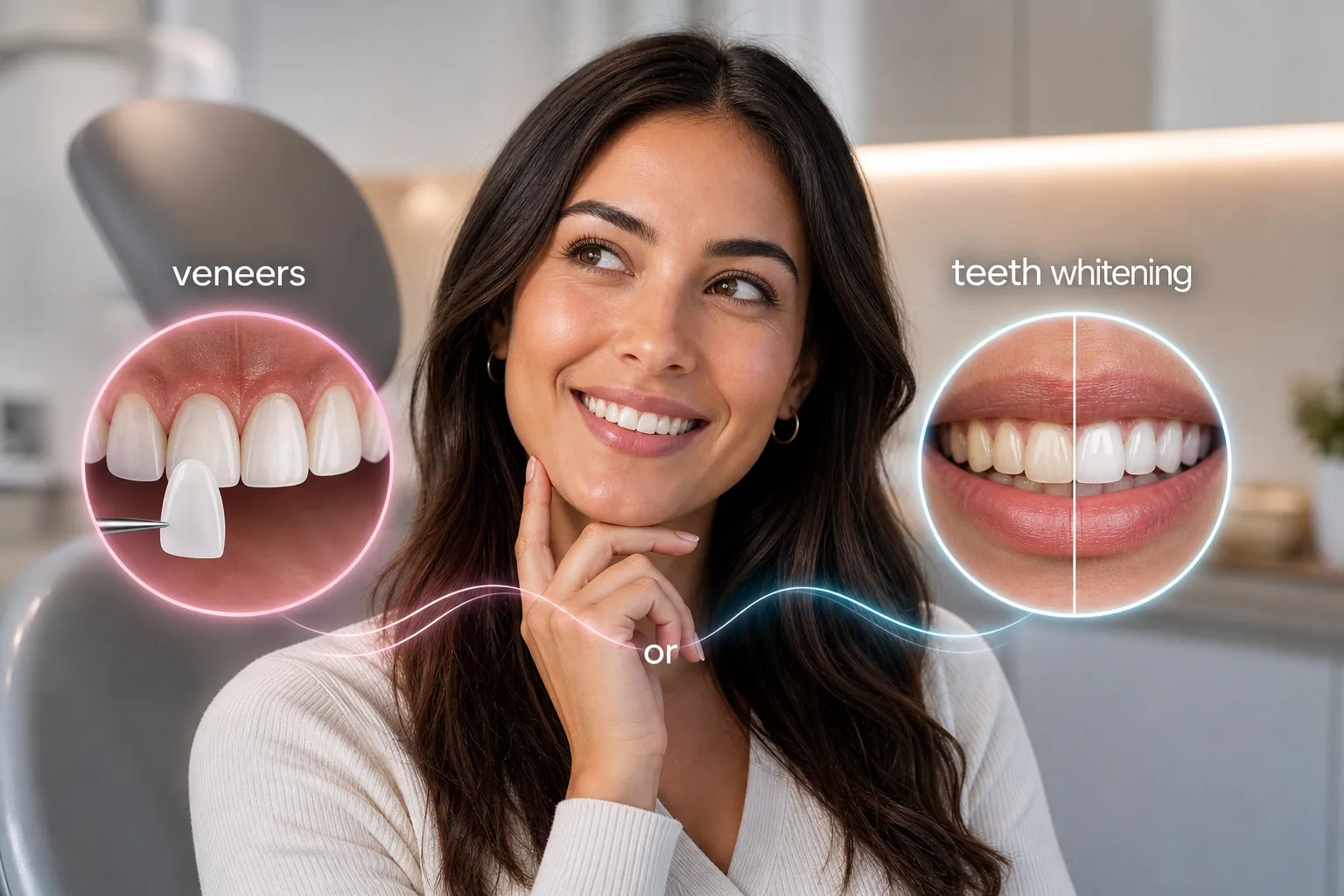
Veneers and Teeth Whitening: Which Is Right for You?
Veneers and teeth whitening are two of the most popular cosmetic dental treatments available today, but they solve fundamentally different problems. Many patients walk into a cosmetic consultation expecting a straightforward choice between the two, only to discover that these treatments work through entirely different mechanisms and produce very different kinds of results. Choosing the wrong one doesn’t just waste money; it can leave you with a smile that looks nothing like what you had in mind.
This question comes up regularly during smile consultations at Envy Dental, Implants & Esthetics in Wichita. In Dr. Neda Vessali’s experience, patients often arrive having done their research, watched videos, and still feel uncertain which direction makes sense for their specific situation. The answer almost always comes down to five factors: what type of staining you have, what you’re hoping to change, your budget, how long you want results to last, and whether you’re planning to combine both treatments. This guide walks through all of it.
Veneers and teeth whitening: what each treatment actually does
Professional teeth whitening and porcelain veneers are not competing versions of the same cosmetic procedure. They work through entirely different mechanisms, and understanding that difference is the foundation of making the right choice.
How professional whitening treats tooth discoloration
In-office bleaching works by applying a concentrated hydrogen peroxide or carbamide peroxide gel directly to natural tooth enamel. Because enamel is porous, the peroxide diffuses into the tooth structure and breaks down the chromogenic molecules responsible for discoloration, lightening the underlying tooth color from within. Professional in-office treatments use higher concentrations and produce results in a single session. Dentist-supervised take-home trays use a lower concentration gel over multiple applications at home, also producing strong results when used consistently. The critical limitation: whitening only works on natural tooth structure. It cannot change the shade of any restoration, including fillings, crowns, or veneers.
What veneers cover that whitening can’t reach
Veneers take a completely different approach. Rather than treating a stain, they cover it. A thin custom shell is bonded to the front surface of the tooth, giving the dentist direct control over the final color, shape, length, and surface texture. Porcelain veneers are fabricated in a dental lab to precise specifications and are well regarded for their durability, light-reflective appearance, and long-term stain resistance. Composite veneers are sculpted chairside in a single appointment, making them faster and more affordable, though they are more prone to staining over time and don’t last as long. Both options let the dentist set the final shade to whatever the patient wants, something whitening alone simply cannot do.
Matching your stain type to the right treatment
The type of discoloration you have is the most important factor in determining which treatment will actually work. This isn’t a preference question; it’s a clinical one. Understanding where your staining originates, on the surface or deep within the tooth, goes a long way toward narrowing down the right path.
Extrinsic stains: when whitening is usually enough
Extrinsic staining develops on the outer surface of enamel from things like coffee, tea, red wine, tobacco, and plaque buildup. Because these stains sit within or on top of the enamel layer, they respond well to professional bleaching. If your teeth are structurally healthy, reasonably uniform in color, and you’re mainly dealing with yellowing or darkening from lifestyle habits, professional whitening is the logical starting point. You’ll get a noticeable improvement without any alteration to your actual tooth structure.
Intrinsic discoloration: when veneers are the stronger answer
Intrinsic staining originates inside the tooth, in the dentin layer, and it doesn’t respond to whitening the same way. The most common causes include tetracycline antibiotic exposure during tooth development, fluorosis, trauma that caused internal bleeding within the tooth, and the natural dentin darkening that comes with age. Whitening can lighten some intrinsic stains with extended treatment, but the results are often inconsistent, especially for the gray or banded discoloration associated with tetracycline. Based on clinical experience, mild tetracycline cases can show some improvement with professional bleaching, but severe or banded cases are more reliably resolved with porcelain coverage. When discoloration is too deep, too resistant, or too uneven for whitening to produce a reliable result, veneers give you predictable, lasting control over the final appearance.
Cost and longevity, compared side by side
Both treatments represent real investments. Looking at cost alongside longevity gives you a much clearer picture of the actual value you’re getting over time.
What you’ll invest in porcelain or composite veneers
Porcelain veneers average around $1,500 to $1,800 per tooth nationally, with the range extending from approximately $900 to $2,500 depending on location and provider. A standard smile makeover typically covers eight to ten upper front teeth, so the total investment reflects that per-tooth cost across however many teeth are being treated. With proper care, porcelain veneers typically last 10 to 15 years, and many last 20 years or longer. Composite veneers are more accessible at $250 to $1,500 per tooth and can be completed in a single appointment, though they are more prone to staining over time and will eventually need replacement or refinishing. For either material, longevity depends on oral hygiene, bite alignment, and avoiding habits like teeth grinding, nail-biting, or chewing on hard objects.
The real cost and lifespan of professional whitening
In-office professional whitening typically runs $500 to $1,000 per treatment session. Dentist-supervised take-home tray systems are more accessible at $100 to $400 and produce comparable results over a longer timeline. The trade-off is maintenance: whitening results typically last several months to about three years, depending heavily on diet and lifestyle. Coffee drinkers and smokers will see results fade faster, and touch-up treatments are usually necessary to maintain brightness over time. Whitening costs less upfront, but the ongoing maintenance is part of the real cost calculation.
The right order when combining veneers and teeth whitening
Many patients want both: whitened natural teeth and veneers on specific teeth that need more correction than bleaching can provide. When that’s the plan, sequencing matters more than most people realize.
Why whitening always comes before veneers
Veneers are fabricated to match a specific shade. If natural teeth are whitened after veneers are already in place, the surrounding teeth brighten while the veneers stay exactly the same color, creating a visible mismatch. The correct approach is to whiten all visible natural teeth to the desired final shade first, then design and place veneers to match that new, brighter baseline. This ensures color harmony across the full smile. The only exception is a complete full-arch restoration where all visible teeth will be covered, since the veneers define the shade directly without any natural tooth reference remaining.
The 2-week stabilization window and why it matters
After whitening, tooth color doesn’t stabilize immediately. As enamel rehydrates in the days following treatment, the shade continues to shift slightly. Standard cosmetic dentistry protocols recommend waiting approximately 7 to 14 days after the final whitening session before taking impressions, selecting the veneer shade, or beginning bonding. Skipping this window risks fabricating veneers to a shade that doesn’t match once the natural teeth fully settle. It’s a short wait that prevents a significant and costly mismatch.
What actually happens when you try to whiten existing veneers
This is one of the most common points of confusion for patients who already have veneers and wonder why their whitening treatments aren’t producing the same results as before.
Porcelain veneers and bleaching agents: what the science shows
Porcelain is a dense, vitrified ceramic with very low porosity. Professional bleaching works by peroxide diffusing through the porous structure of natural enamel, which simply doesn’t happen the same way in porcelain. As a result, the veneer shade doesn’t change with whitening. What does change is the surrounding natural teeth, which lighten while the veneer stays the same, making the veneer appear darker by comparison even though its own color hasn’t shifted at all. Repeated or aggressive bleaching around existing veneers can also roughen the veneer surface over time, increasing micro-roughness in a way that makes future staining more likely rather than less.
Composite veneers and the mismatch risk
Composite veneers present a more complicated picture. Research suggests a minor color shift is possible after bleaching, but the results are inconsistent and often come with increased surface roughness that leads to faster re-staining. In clinical practice, whitening isn’t the right fix for a composite veneer that looks dull or stained. Polishing or replacement is the appropriate solution, not bleaching. If you have composite veneers and want to refresh your smile, bring that conversation to your dentist rather than experimenting with whitening products on your own.
Making the right decision between veneers and teeth whitening
Three scenarios cover most patients weighing these options. If your discoloration comes mainly from lifestyle habits and your teeth are structurally sound, professional whitening is the right place to start. It’s the most conservative approach, preserves your natural tooth structure, and produces a genuinely noticeable improvement. If your discoloration is deep, uneven, or has resisted whitening in the past, veneers give you reliable and lasting control over your smile’s final appearance. And if you want to combine teeth whitening and veneers, the sequence is clear: whiten first, wait two weeks for the shade to stabilize, then match your veneers to the new baseline.
Neither treatment is universally better. The right answer depends entirely on your specific situation, what type of staining you have, how many teeth are involved, what changes you’re hoping to make, and your long-term goals for your smile. That’s a conversation worth having with a dentist who can actually look at your teeth.
If you’re in Wichita and ready to get a clear answer for your specific smile, Dr. Neda Vessali at Envy Dental, Implants & Esthetics offers cosmetic consultations designed to take the guesswork out of this decision. Dr. Vessali will assess your stain type, evaluate your tooth structure, and put together a personalized plan that fits your goals and your timeline. Schedule your cosmetic consultation at Envy Dental, Implants & Esthetics today, it’s the clearest next step toward understanding whether veneers and teeth whitening, one or both, are right for your smile.
Frequently asked questions about veneers and teeth whitening
Can you whiten veneers?
No. Veneers, whether porcelain or composite, do not respond to bleaching agents the way natural enamel does. Porcelain is too dense for peroxide to penetrate, so the veneer shade stays fixed. Attempting to whiten over veneers will lighten your surrounding natural teeth while leaving the veneer unchanged, creating a noticeable color mismatch.
How long does professional teeth whitening last?
Results vary based on diet and lifestyle, but professional whitening typically lasts anywhere from several months to about three years. Patients who drink coffee, tea, or red wine frequently, or who smoke, will see results fade sooner. Periodic touch-up treatments help maintain brightness over time.
When should I choose veneers over whitening?
Veneers are the stronger choice when discoloration is intrinsic (originating inside the tooth), when staining is too deep or uneven for bleaching to produce a consistent result, or when you also want to address shape, length, or structural issues. If your teeth are otherwise healthy and the staining is surface-level, whitening is usually the better starting point.
Should I whiten before getting veneers?
Yes, if you plan to combine both treatments, whitening should always come first. Veneers are color-matched to your natural teeth at the time of fabrication. Whitening after placement will brighten your natural teeth while leaving the veneers the same shade, resulting in a mismatch. Whiten first, allow 7 to 14 days for the shade to fully stabilize, then proceed with veneer color selection and placement.