
What are All-on-4 dental implants, and how are they different from regular implants? If you’ve been wondering that, you’re not alone. At Envy Dental, Implants & Esthetics in Wichita, Dr. Vesali hears this question constantly during consultations: “Is All-on-4 the same thing as getting implants, or is it something completely different?” The phrase sounds clinical, and most patients who first hear it feel exactly that way, unclear on whether it applies to their situation, unsure of the cost, and uncertain how it compares to a standard implant.
The honest answer is that All-on-4 and regular implants operate at entirely different scales. This article breaks down what All-on-4 full-arch implants actually are, how they compare to traditional single-tooth implants, what the timeline looks like, who qualifies, and what treatment realistically costs in 2026. No promises, no pressure, just a clear explanation so you can walk into a consultation knowing exactly what to ask.
What All-on-4 dental implants actually are
Four implants, one complete arch of teeth
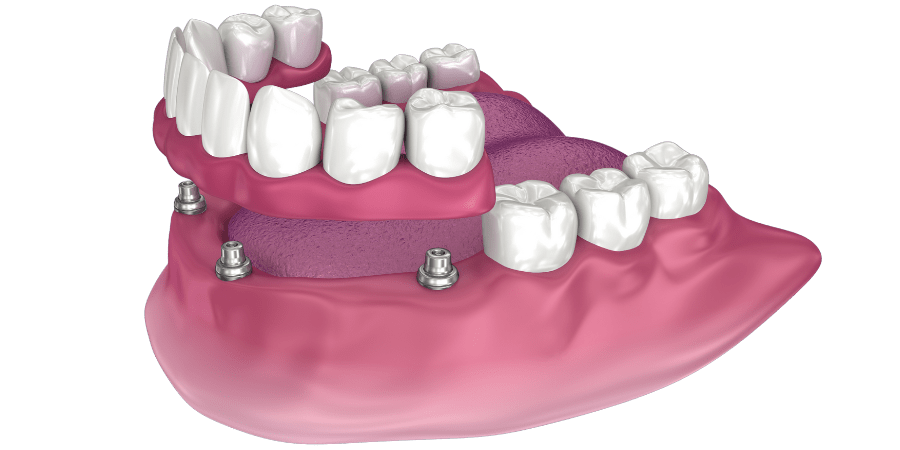
Instead of replacing each missing tooth individually, All-on-4 uses four carefully positioned implants to anchor a full-arch fixed bridge. The result looks and functions like a complete set of natural teeth, not a removable appliance you take out at night. Because the bridge is secured directly to the implants, it stays in place the same way natural teeth do.
Many patients have also heard this described as “teeth-in-a-day.” That nickname refers to the fact that most patients leave their surgery appointment with a temporary set of functional teeth already attached, not a gap in their smile. It’s one of the features that sets this approach apart from most other major dental procedures.
Why it’s called a fixed hybrid denture
The “fixed” part of that name means the bridge is screwed or cemented to the implants and cannot be removed at home. This is a critical distinction from traditional dentures, which rest on the gums and can be taken out. The “hybrid” part refers to the combination of implant technology and a prosthetic arch, typically made from acrylic or high-grade zirconia, designed to replicate the look of natural teeth and gum tissue.
This is not a fallback option for patients who couldn’t qualify for something better. It is a well-documented, specifically engineered full-arch restoration system developed for people who have lost most or all of their teeth and want a permanent, fixed solution they can rely on for years.
How All-on-4 differs from what most people picture
When most people hear “dental implants,” they picture a single implant topped with a crown to replace one tooth. All-on-4 operates at a completely different scale, replacing an entire jaw rather than a single tooth. A traditional single implant handles one site. All-on-4 handles a full arch with just four strategically placed posts. Understanding that distinction is the starting point for evaluating whether this approach fits your situation.
How All-on-4 dental implants differ from regular implants
The implant count and what it changes
A full-arch restoration using traditional single-tooth implants typically requires six to eight implants per jaw. All-on-4 achieves comparable structural support with just four, using two front implants placed vertically and two rear implants placed at an angle. That angled placement is intentional: it distributes bite force more efficiently and allows the back implants to anchor into denser areas of bone without requiring exact placement where a tooth used to sit. Fewer implants means fewer surgical sites and a meaningfully less complex procedure overall.
Why All-on-4 often skips bone grafting
One of the most significant advantages for patients with bone loss is that All-on-4 frequently avoids the need for bone grafting. Traditional single-tooth implants placed in areas of reduced bone volume often require a graft to rebuild enough structure for stable placement, adding a separate surgery, additional healing time, and more cost. Because All-on-4’s angled posterior implants reach denser bone toward the front of the jaw, many patients who would need grafting under a traditional plan can proceed without it. Whether grafting is needed in your specific case is anatomy-dependent; only 3D imaging can confirm that.
Immediate loading vs. the traditional healing timeline
Traditional single implants require a waiting period after placement before a final crown is attached, giving the implant time to fully integrate with the bone before bearing chewing loads. All-on-4 is designed for immediate loading, meaning a temporary fixed prosthesis is attached the same day as surgery in most cases. Patients leave with functional teeth already in place. Healing still occurs during this period, the temporary bridge is simply built to carry lower stress loads while osseointegration progresses over the following months.
What the All-on-4 process looks like from first appointment to final teeth
Consultation, imaging, and surgery day
The process starts with a thorough evaluation: a clinical exam, dental X-rays or 3D cone-beam imaging, a review of your medical history, and a conversation about tooth color, shape preferences, and any remaining teeth that need extraction. Surgery is performed under local anesthesia and often IV sedation. The surgeon places four implants, attaches abutments, sutures the gums, and in most cases secures the temporary full-arch bridge before you leave.
Most patients are genuinely surprised by how manageable surgery day feels compared to what they imagined. Sedation options make the procedure far less intimidating than the word “surgery” implies, and leaving with functional teeth in place makes the experience feel concrete and forward-moving rather than just the beginning of a long wait.
The healing phase: living with your temporary bridge
After surgery, your implants need time to fuse with the jawbone. This biological process, called osseointegration, typically takes three to six months. During this period, you wear the temporary fixed bridge. It is functional but built for lower chewing loads while healing progresses. Soft-food guidelines and regular follow-up visits apply throughout this phase.
Patients often report that the healing period is when the investment starts to feel real. They have teeth, they can smile and speak confidently, and they’re not removing anything at night. Living with the temporary bridge gives them a meaningful preview of what the permanent result will feel like before it’s ever placed.
When you receive your permanent prosthesis
Once imaging confirms successful osseointegration, digital scans or impressions are taken for the definitive prosthesis, usually made from high-grade acrylic or zirconia. The lower jaw tends to integrate faster, often around four months, while the upper jaw commonly takes closer to five months. From surgery to permanent teeth, most cases are completed within six months to a year, depending on individual healing and any additional procedures involved.
Who qualifies for All-on-4 and who may need a different plan
The factors that support candidacy
Strong candidates typically have adequate bone volume in the front of the jaw, healthy or treatable gum tissue, and no uncontrolled systemic conditions that compromise healing. All-on-4 was specifically designed for patients with moderate bone loss, which is why more people are eligible than they expect. The angled posterior implants work around areas of reduced bone density, making this an option for many patients who would be told they need grafting under a traditional implant plan. Prior tooth loss, even years ago, doesn’t automatically exclude you, though the longer teeth have been absent, the more bone resorption typically occurs.
Factors that increase risk or require attention first
Smoking is one of the clearest risk factors: it reduces blood flow, slows healing, and is associated with higher rates of peri-implantitis and implant failure. It isn’t always an absolute disqualifier, but most providers require cessation before surgery. Uncontrolled diabetes raises infection risk and disrupts healing; well-controlled diabetes, however, is generally compatible with All-on-4, and many patients in that category proceed without issue. Other factors reviewed during candidacy screening include osteoporosis, bisphosphonate medications, immune suppression, and recent head-and-neck radiation.
Only a 3D scan and a full clinical evaluation can accurately determine candidacy. Knowing the general factors helps you prepare for that conversation, but no online resource replaces sitting down with a qualified provider who can assess your actual anatomy and health history together.
What All-on-4 costs in 2026 and what the long-term data shows
Realistic cost ranges per arch
In 2026, All-on-4 full-arch restoration in the U.S. typically runs $15,000 to $30,000 per arch, with many cases landing in the $20,000 to $35,000 range depending on materials, location, sedation, and whether extractions are included. For both arches, expect a total range of roughly $30,000 to $60,000. A traditional full-arch restoration using six to eight single implants with a fixed bridge runs substantially higher, often $30,000 to $60,000 per arch, because of the greater implant count, more complex surgery, and frequent need for bone grafting. Treating both arches with traditional protocols can reach $60,000 to $120,000 or more.
What the long-term success data actually says
Published studies report implant survival rates in the 94% to 99% range at 10-year follow-up for All-on-4, with prosthesis survival often reported even higher. At least one published longitudinal 10-year study reported 94.8% implant-level success alongside 99.2% prosthesis survival, reflecting the durability of the overall framework even when individual implant-level complications occur. It’s worth understanding the difference between survival (the implant is still in place) and clinical success (no meaningful bone loss, no active infection, no prosthetic failure). Complication rates, including peri-implantitis and prosthetic fractures, do accumulate over time, which is why consistent follow-up care and oral hygiene matter as much as the surgery itself.
How most patients pay for treatment
Dental insurance rarely covers the full cost of implant reconstruction. Annual plan maximums of $1,000 to $2,000 make meaningful coverage limited at best, and most patients cover the majority out of pocket. Patients commonly rely on a combination of self-pay discounts, third-party dental financing through programs like CareCredit or LendingClub, and in-office payment plans that spread costs into manageable monthly installments. Many practices offer 0% promotional financing for qualifying terms, particularly for full-arch cases. Transparent, itemized cost breakdowns and honest financing conversations are worth prioritizing when you evaluate providers.
Questions to bring to your first All-on-4 consultation
The questions worth asking before you commit
Ask your provider to walk through the imaging findings in plain language: what does your bone density look like, where are the potential complications, and does anything in your anatomy require modifications to the standard plan? Ask specifically whether you’ll need extractions, whether bone grafting is likely in your case, what the temporary bridge will look and function like during healing, and what materials are being used for the permanent prosthesis. Material choices affect both cost and long-term durability, so the answer matters.
Also ask about your specific timeline, who performs the surgery, what sedation options are available, and what aftercare looks like in the first weeks post-surgery. These aren’t obscure questions. They reveal how well a provider understands your case and how honestly they communicate before any commitment is made.
How Envy Dental in Wichita approaches the candidacy conversation
At Envy Dental, Implants & Esthetics, Dr. Vesali and her team offer consultations designed to answer these questions without pressure. Using 3D imaging and a detailed clinical review, the goal is to give you a clear, honest picture of whether a full-arch implant solution is the right fit for your jaw, your health, and your budget, including what the imaging actually shows, realistic timelines and costs, and every option available before any decision is made.
For Wichita-area patients exploring full-arch restoration who want a local, judgment-free evaluation from a provider who understands both the clinical and personal sides of this decision, Envy Dental is a practical and straightforward next step.
What this comes down to for your decision
All-on-4 is a full-arch, four-implant solution built for patients with extensive tooth loss who want a permanent, fixed result. It is not a single-tooth replacement system, and it’s not equivalent to traditional dentures. Understanding how All-on-4 dental implants differ from regular implants comes down to scale, surgical approach, and who the treatment is designed for, and the right choice between All-on-4 and other approaches depends on your bone anatomy, health history, and goals. A 3D scan and proper consultation are the only reliable way to determine whether this treatment fits your situation.
You now have the foundation to walk into that conversation with confidence. Bring your questions, ask for clear answers, and take the time you need. A decision this significant deserves a provider who earns your trust before you commit to anything.