
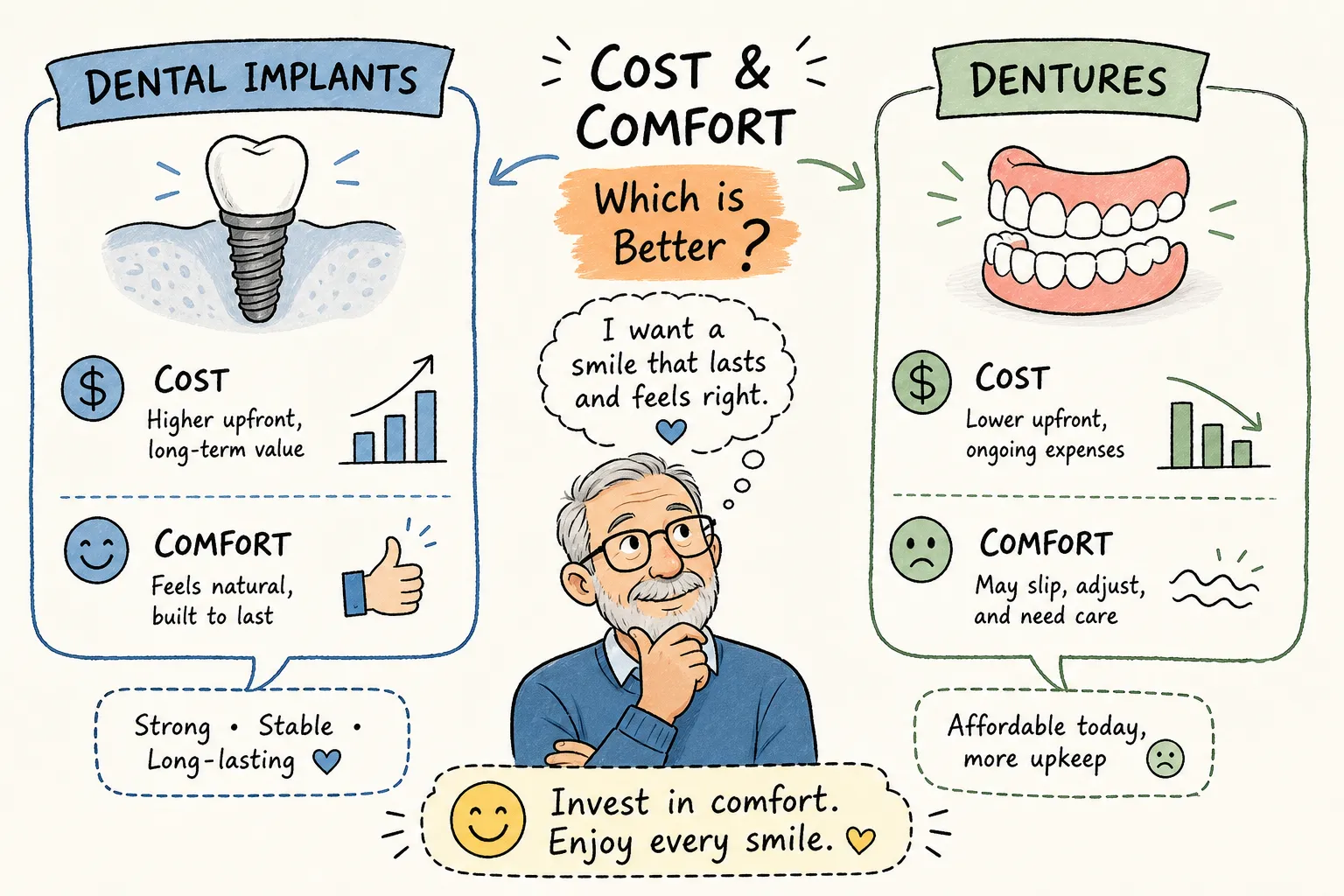
If you’re trying to decide which is better for missing teeth, implants or dentures in terms of cost and comfort, you’re not alone, and the answer isn’t as simple as the upfront price tag suggests. Picture this: you’re sitting across from your dentist, and the conversation has shifted from routine cleaning to something bigger. You need to replace a missing tooth, or maybe several. Two folders slide across the desk: dental implants on one side, dentures on the other. The numbers are different, the timelines are different, and the commitment feels very different. Most people leave that appointment overwhelmed, not informed.
That’s a conversation our team at Envy Dental, Implants & Esthetics in Wichita has often. Our goal is never to steer you toward the more expensive option. Our goal is to help you walk out of the office knowing exactly what each path costs, how it feels, and whether it fits your life. This breakdown gives you that picture before you ever book a consult.
Which Is Better for Missing Teeth: Upfront Cost, Implants or Dentures?
The sticker price difference between implants and dentures is real, and it’s significant. A single completed dental implant, meaning the post, abutment, and crown together, runs between $3,000 and $6,000 in the U.S. right now. That’s one tooth. If you’re replacing a full arch of teeth with an All-on-4 restoration, the investment climbs to $15,000 to $35,000 per arch depending on the materials, the complexity, and whether additional procedures like bone grafting are needed.
Dentures tell a very different financial story on day one. Economy dentures start around $600 to $3,000. Mid-range sets typically fall between $1,000 and $3,000, while premium options can reach $4,000 to $8,000 or more. A conventional full set (upper and lower plates) averages around $1,968 nationally. On upfront cost alone, dentures win, and that’s worth saying plainly rather than dancing around it.
There’s a middle-ground option worth knowing about: implant-supported overdentures. These attach a removable denture to two to four implant posts for added stability, and they typically run $5,000 to $15,000 per arch. They offer more security than conventional dentures without the full commitment of a fixed implant bridge. For many patients, they represent an accessible first step toward an implant-based solution.
The danger is stopping the cost analysis here. Upfront price is one data point in a much longer financial picture, and when you look at 10- or 20-year totals, the calculus shifts considerably.
Which Is Better for Missing Teeth: Long-Term Cost Over 10 to 20 Years
This is where the math gets interesting, and where a lot of patients reconsider their first instinct. Dentures are not a one-time purchase. They require periodic relines as your jaw changes shape, occasional repairs, daily adhesive products, and full replacement every five to ten years. When you add all of that together over a decade, total denture expenses commonly reach $6,000 to $17,500. That figure can surprise people who assumed the lower upfront cost meant lower overall cost.
Dental implants work differently over time. The titanium post that integrates into your jawbone is designed to last 20 years or more, and many last a lifetime. The visible crown sitting on top may need replacement somewhere in the 10- to 20-year range, depending on wear. Beyond that, maintenance looks a lot like caring for natural teeth: brushing, flossing, and routine checkups. No adhesives, no reline appointments, no full replacement cycle.
Research suggests the break-even point most patients don’t think about falls somewhere in the 10- to 20-year window. By that point, a denture patient has often replaced their appliance at least once and accumulated years of adhesive and adjustment costs. An implant patient has spent relatively little beyond routine care. The option that costs more on day one frequently costs less over a lifetime. Bringing that long-term picture into any implants-vs.-dentures cost discussion changes everything.
Which Is Better for Missing Teeth: Daily Comfort, Implants or Dentures?
Cost comparisons are rational. Comfort is personal, and it shapes how you feel about your teeth every single day. Research consistently shows that implant-supported options outperform conventional dentures on patient satisfaction. One study measured comfort scores of 8.9 out of 10 for implant overdenture patients compared to 6.5 for conventional denture wearers, and that’s not a small gap.
Denture wearers describe a predictable set of daily friction points. Appliances can shift during conversation or meals. Adhesives are a recurring inconvenience. Sore spots develop where the denture base rubs against the gumline, especially as the jaw continues to change shape over time. Removing dentures at night is a routine that many patients find psychologically difficult, because it’s a constant reminder that their teeth are prosthetic rather than permanent.
Implant patients, after healing is complete, typically describe something much closer to normal. There’s nothing to remove, nothing to reattach, and no product to apply before eating. Stability is the defining quality of implant-supported teeth, and it affects everything from how you eat to how you feel when you’re talking in a meeting or laughing at dinner. Patient satisfaction data across multiple studies generally shows a clear advantage for implant options in comfort, speech clarity, and retention.
Chewing, Eating, and What You May Have to Give Up
Food is not a small thing. The ability to eat what you want, without planning around your teeth, is a quiet but significant part of quality of life. Conventional dentures reduce biting force substantially. Hard foods like raw carrots, apples, tough cuts of meat, and nuts often become difficult or genuinely painful. Sticky foods are a hazard because they can dislodge an appliance mid-meal. Many denture wearers gradually shift their diet without realizing they’re doing it, simply avoiding things that feel risky.
Clinical studies show that implant-supported teeth restore masticatory function far more effectively. One study found chewing efficiency in implant overdenture patients was approximately 76% better than in conventional denture patients, measured by how efficiently food was broken down per chewing stroke. Another found patients needed 42% fewer chewing strokes to achieve the same result. In practical terms: you can eat more foods, chew more naturally, and stop planning your menu around your prosthetic.
All-on-4 restorations and implant-supported overdentures sit on a spectrum between conventional dentures and fully natural teeth. They won’t restore 100% of original bite force in every case, but the dietary freedom they offer is meaningfully greater than what removable conventional dentures can provide. For patients who have been quietly avoiding corn on the cob or steak for years, this difference matters deeply.
Candidacy: Who Qualifies for Implants and When Dentures Are the Smarter Path
Not everyone is an implant candidate on the first visit, and a trustworthy provider will tell you that directly rather than upselling you into a procedure your body isn’t ready for. Four clinical factors shape implant candidacy more than anything else: bone density, diabetes status, smoking history, and age.
Bone density matters because the implant post must fuse with the jawbone through a process called osseointegration. If bone volume is insufficient, the implant has nothing solid to anchor to. For some patients, a bone graft can restore enough density to make implants viable. Grafts typically add $549 to $5,148 to the overall cost depending on complexity, but they can open the door to implants for patients who would otherwise be told no.
Systemic health plays an equally important role. Diabetes that is well-controlled is generally compatible with implants. Uncontrolled diabetes, however, significantly slows healing and increases infection risk, making implant failure more likely. Smoking roughly doubles implant failure rates according to some studies, and patients who smoke and are unwilling or unable to stop are not strong candidates. Age is not a disqualifying factor by itself, but jaw growth must be complete before implants are placed, which typically rules out teenagers.
When bone loss is severe, systemic conditions are uncontrolled, or a patient is an active heavy smoker, dentures are not a consolation prize. They are the clinically appropriate recommendation. The right tool depends on the patient, not on which option sounds more impressive. Our team will lay out both paths honestly and help you understand exactly where you stand medically before any decision is made.
How to Explore Both Options in Wichita Without Financial Pressure
At Envy Dental, Implants & Esthetics, Dr. Neda Vessali walks every patient through both options in detail before any treatment is recommended. That means reviewing your bone health, discussing your medical history honestly, and building a realistic financial plan that accounts for your actual timeline, not just today’s price tag. The practice is built around a judgment-free environment, specifically because so many patients come in having avoided the dentist for years and feel anxious about cost conversations.
To make care as accessible as possible, Envy Dental offers comprehensive payment plans and financing options tailored to your monthly budget. Patients can take advantage of point-of-sale financing through Cherry (offering fast pre-approvals without hard credit checks), CareCredit, Sunbit, Proceed Finance, LendingClub Patient Solutions, or flexible in-house payment structures. Health Savings Accounts (HSA) and Flexible Spending Accounts (FSA) can also be applied toward qualifying procedures.
Importantly, Envy Dental accepts more insurance plans than surrounding competitors in the Wichita area. While dental insurance generally doesn’t cover 100% of major cosmetic restorations, PPO plans frequently help offset key restorative steps—such as extractions, bone grafting, diagnostic 3D imaging, or protective crowns—significantly lowering your total out-of-pocket costs.
Phased treatment, starting with the most urgent needs and building toward a complete restoration over time, is also a practical option for patients managing tighter budgets. The full implant process, from consultation to final crown placement, typically takes three to eight months. Knowing that timeline up front helps patients plan financially and logistically without surprises.
Before committing to any tooth replacement option, bring these questions to your consultation:
- What is my current bone volume, and do I need a graft before implants are possible?
- Which insurance plans do you accept, and how can we maximize my coverage?
- What financing or monthly payment plan options (like Cherry) are available for my care?
- What is my honest timeline from consultation to final restoration?
So, Which Is Better for Missing Teeth, Implants or Dentures in Terms of Cost and Comfort?
Here’s the honest summary. When evaluating which is better for missing teeth, implants or dentures in terms of cost and comfort, dental implants come out ahead on long-term value and daily comfort for most patients who qualify. They last longer, feel better, allow more dietary freedom, and typically cost less over a lifetime than the upfront number suggests. Dentures win on day-one affordability and remain the clinically correct choice for patients with severe bone loss, uncontrolled systemic conditions, or other factors that make implant surgery too risky.
Which is better for your specific situation depends on your bone health, your budget timeline, and your lifestyle priorities. Those factors are personal, and no article can make that call for you. What a good consultation can do is give you a clear picture of where you stand, what each path genuinely costs, and what you can realistically expect in terms of comfort and function over the years ahead.
If you’re weighing these options and want an honest assessment, Envy Dental, Implants & Esthetics in Wichita is a great place to start that conversation. Book a consultation with Dr. Neda Vessali and leave with a clear picture of your options, your financing choices, and a timeline that fits your life.